
What a Perc Test Reveals Before a Septic System Goes In
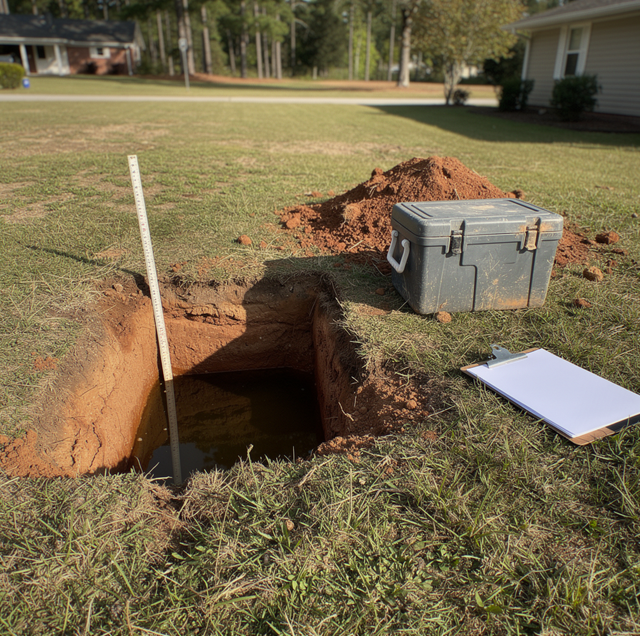
A percolation test, or perc test, has one job: find out how fast water moves through the soil where a drain field is about to sit. A technician digs a test hole, soaks it, then times how far the water level drops over a set period. That rate, not the soil's name, decides how much drain field area the site needs.
Before your new system goes into the ground, this test keeps your design honest. Skip past what it measures, and you're trusting a guess instead of a number that describes your own soil. What you'll find below covers what the test actually checks, what a marginal result changes, and how it differs from checking a field your system already relies on.
How a Perc Test Actually Works
A percolation test measures the rate at which pre-soaked soil absorbs water, expressed in minutes per inch of drop. A technician digs a test hole to the depth the drain field trenches will actually sit at, saturates the soil so dry, thirsty clay can't fake a faster reading, then times how far the water level falls over a set interval. Thorough soil testing before installation is what confirms that site conditions will support a conventional system. An installer plugs that number, not a guess based on how the yard looks from the driveway, straight into the design.
That single rate carries more weight than almost any other input into your system's design. A fast drainage rate lets the same volume of wastewater soak away through a smaller footprint, while a slow rate spreads that same volume over more square footage of trench because the soil can't take it as quickly per square foot. Even a small change in the reading can add hundreds of square feet to the drain field a design calls for. Two lots that look identical from the road can call for drain fields of very different sizes once their perc rates are actually in hand.
None of that is visible before the test runs. You can look at a lot all day long and still not know whether its soil drains in five minutes or fifty, and closing that exact gap is the entire reason a perc test exists. Until you know the number, you're only guessing.
Ask the installer for the actual rate in minutes per inch, not a pass-or-fail summary. That number, not the general soil type, determines whether a standard field works or an engineered system takes its place.
The Step-by-Step Process Before Any Tank Goes In
The test itself follows a set order, and each step exists to keep the reading honest. First, a hole gets dug to the depth the drain field trenches will occupy, not a shallow scrape near the surface, since the finished system relies on soil at that exact depth. Second, the hole is pre-soaked, often over several hours or a full day, so the soil is already saturated when the timed reading starts, and it isn't absorbing a first burst of water the way dry soil would, which would make the ground look faster than it really drains once wet. Third, water gets added to a measured starting depth, and the drop is timed and logged until a stable number emerges.
Ask to see the perc log itself, not just a pass or fail: the depth of the hole, how long it pre-soaked, and every timed reading until the number settled. One reading on its own is not a stable rate.
That same test hole often does double duty. Because it sits open and full of water for hours, it can also catch a seasonal high water table, a level that rises during wet months and can crowd out the working depth your drain field needs, even on soil that otherwise percolates just fine. A rate that looks workable in a dry month can tell a very different story once that seasonal reading gets added to the picture, and a good tester logs both numbers, not just the one.
What Clogs a Test Pit's Walls and Skews the Reading?
Digging equipment can glaze or smear the sides of a test hole, especially in denser clay, pressing fine particles into the pore spaces the way a trowel smooths wet concrete. A smeared wall behaves nothing like the soil around it: water that would normally soak sideways into open pore space instead meets a compacted skin, and the hole measures far slower than the ground around it ever would once a drain field trench opens it back up.
A careful tester scarifies the sidewalls and the bottom of the hole before the timed reading starts, roughening that smeared surface back to open soil so the number reflects the ground itself, not the tool that dug it. Skipping that step is one of the more common reasons a lot gets flagged as marginal or failing when the native soil, dug and read correctly, would actually have performed fine.
What a Marginal or Failed Result Changes
A slow or borderline result doesn't automatically rule out your property. Low-pressure dosing and mound systems are designed for sites that don't perc well: challenging soil conditions, properties with limited space, and lots where soil depth, proximity to bedrock, or high water tables prevent a standard drain field installation.
Both approaches change how the same volume of wastewater reaches the soil, without changing how much wastewater the household actually produces. A low-pressure dosing system pumps wastewater out in small, controlled doses through a network of small-diameter pipes, timed so that the soil is never asked to absorb more than it can handle at once. A mound system raises the absorption area above the native ground in imported sand, effectively building a better-draining layer of soil on top of the ground you actually have, at added cost and construction time.
What changes is the engineering, not the goal. Every configuration still has to move the same wastewater into ground that can actually accept it; a failed perc just means your site needs more design and more built structure to get there, not a plain gravel trench doing the job on its own.
Why This Differs From Checking a Field That's Already In
A perc test happens before a shovel ever breaks ground for the tank or the trenches, on soil that has never carried a drop of wastewater. It answers one question: how will this ground behave once a system gets built on it? That's a different exercise from evaluating a drain field already in service, where the soil carries years of wastewater, with biomat buildup and root activity working against it, and where a slow reading points toward restoring lost capacity rather than sizing a design from scratch.
Confusing the two leads to the wrong conclusion either way. If you're troubleshooting a sluggish, years-old field, you're not looking at a perc-test problem; you're looking at a system that has simply aged past what its original design accounted for. A perc test only ever describes the soil at the exact moment a system is first being planned.
Where Heavy Clay Complicates the Reading
Clay-heavy soils drain far more slowly than the sandy loam common elsewhere, and that difference shows up directly in the perc numbers a test produces on them. Dense clay swells when wet and traps water between its particles, passing it far more slowly than sandier ground does, so a rate that would be unremarkable elsewhere can land in marginal territory here. That's why an installer on clay often reaches for engineered options on results sandier ground would call a pass or a fail.
A quick reading in loose, sandy ground and a labored one in dense clay can both end in a system that works fine for decades. What separates them isn't whether the soil passes; it's how much drain field, or what kind of system, that particular rate demands. Either way, you end up with a system built for the ground you actually have.
Frequently Asked Questions
Plan on more than one visit before you have a number you can trust. Pre-soaking your test hole properly can take several hours, and the timed reading that follows runs another hour or so, depending on how your soil responds once it's fully wet.
Yes, in most cases. A failed or marginal result usually means your site needs an engineered option, such as a mound system or a low-pressure dosing setup, not a standard trench field. It rarely makes your lot completely unbuildable, though it does add real design cost and time.
Often, yes. Because your test hole stays open and saturated for hours, it can also reveal a seasonal high water table on your lot, a level that rises in wetter months and needs to stay below the drain field's working depth. Ask your installer directly whether that seasonal reading was taken too.
A licensed installer or a qualified soil evaluator digs the hole, manages the soak, and times the reading, not you. Getting an accurate number depends on following the same process every time, which is why this isn't a job you'd want to take on yourself. Your part is to choose who runs it and review the result.
Once your result is in hand and a design is drawn around it, installation can begin within a few weeks, depending on permitting and scheduling. The result doesn't expire right away, but a long gap between testing and construction is worth flagging if your site has changed in the meantime, such as new grading or drainage work nearby.
Not entirely. A perc test only measures how your soil behaves at the time of testing, before any system is installed on the site. Once a field is built and put into service, other factors start shaping how well it continues to perform: your pumping schedule, household water use, root activity near the trenches, and years of gradual biomat buildup within them. A strong initial rate is a good starting point for your system, not a lifetime promise that it will never need any attention or a pumping visit again.
Planning a new septic installation on a lot with tricky soil — get the ground tested first so the drain field gets sized to what it can actually handle, not a guess based on looks. 3rd Generation Septic serves Lincoln, Pell City, Talladega. Call (256) 330-6960.
