
Do Septic Tank Additives Work? What the Bottle Won’t Say
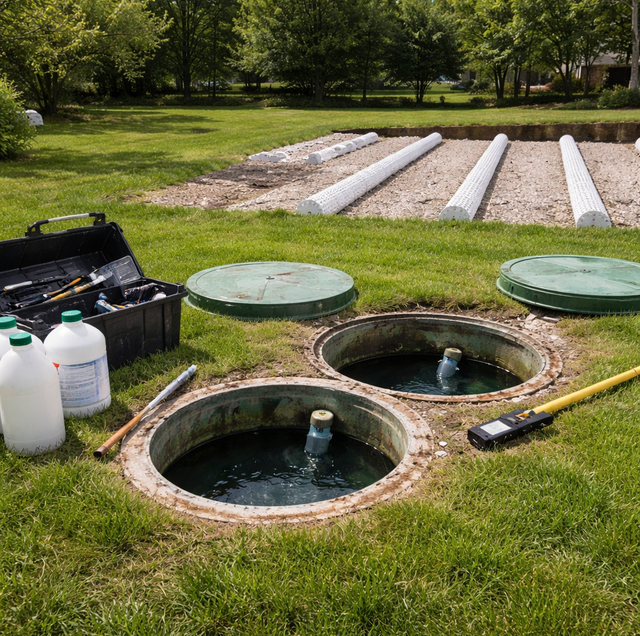
Quick Answer: A healthy septic tank already grows the bacteria it needs from the waste flowing into it, so most biological additives add little you don't already have. Chemical additives are worse than useless: they can dissolve settled solids and push them into the drain field, where they clog the soil and cause the failure they claim to prevent. No additive replaces pumping.
Every hardware store shelf and grocery aisle has a spot for septic tank additives: powders, packets, and jugs that promise to keep your system running, cut odors, and stretch the time between pump-outs. The marketing is reassuring, the price is small next to a service call, and pouring something down the drain feels productive. So the question is fair and worth answering honestly: do these products actually do anything, and if so, is it something your tank needs?
To judge any additive, you first have to know what the tank is doing on its own.
How A Septic Tank Actually Works
A conventional septic system is not a holding tank. It is a small, quiet treatment plant that runs on biology, not chemistry, and understanding that biology is the whole key to the additive question.
Wastewater from the house flows into a buried, watertight tank, usually concrete, holding a thousand gallons or more. Inside, three things happen at once and separate into layers.
Sludge settles: Heavier solids, the stuff that does not float, sink to the bottom and form a layer of sludge. This is where most of the digestion happens.
Scum floats: Fats, oils, grease, and lighter particles rise to the top and form a scum layer that seals the surface and helps hold odors down.
Effluent flows out: Between those two layers sits a middle band of relatively clarified liquid called effluent. As new water enters, an equal amount of effluent exits through an outlet baffle and travels to the drain field, also called the leach field, where perforated pipes distribute it into gravel and soil for final filtering.
The engine running all of this is a population of anaerobic bacteria, microbes that live without oxygen. They arrive on their own in the waste stream and set up residence in the sludge and scum, steadily breaking organic solids into gas, liquid, and a smaller volume of stable residue. A working tank is, in effect, a self-seeding colony. The waste that feeds it also restocks it every single day.
Two facts fall out of this that matter for additives. First, the bacteria are not a supply you have to buy; the system recruits them from ordinary household waste. Second, digestion is never complete. Even a healthy colony leaves behind an inorganic and slowly-accumulating fraction of sludge that no microbe can eat. That leftover layer keeps rising until it either gets pumped out or reaches the outlet and escapes toward the drain field. This is why pumping exists, and it is why no biological trick can cancel it.
The Two Kinds Of Additives
Products sold for septic systems fall into two families, and they behave very differently once they hit the tank.
Biological additives contain bacteria, enzymes, or yeast, sometimes freeze-dried, sometimes as a live culture. The pitch is that they reinforce or restart the microbial population. In a normally used home, that population is already at full strength, so adding more organisms is a bit like watering a lawn during a rainstorm. The tank was not short on what you are pouring in.
Chemical additives are a different animal. Some are inorganic (acids, alkalis, or solvents meant to cut grease or clear a sluggish tank); others are organic solvents. Their selling point is that they dissolve buildup. That is exactly the problem, and it is covered in the next section.
There is a narrow set of situations where reintroducing bacteria has a defensible logic, though evidence that store additives deliver it is thin. If a household dumped a large volume of bleach, disinfectant, or a course of strong antibiotics that killed off the tank's microbes, the colony can dip. Even then, normal use usually reseeds it within days without a purchased product. The additive is not doing something the household could not do by simply resuming ordinary use.
To spot the riskier products on the shelf, read the label's action words. Anything promising to dissolve, break down grease, or open a sluggish tank fast is the chemical type most likely to push solids into your drain field, while biological products describe digesting or seeding instead.
What The Evidence Actually Shows
Independent testing and the position of most public-health and onsite-wastewater authorities land in roughly the same place: additives are not necessary for a properly sized, properly used system, and some do measurable harm. The reasoning holds up when you trace it through the biology described above.
Biological additives face a simple ceiling. A tank that receives daily household waste is not bacteria-starved, so extra microbes have no shortage to fix and little room to establish. Controlled evaluations of these products have generally failed to show they reduce sludge accumulation, improve effluent quality, or lengthen the safe interval between pump-outs in a normal system. They rarely hurt anything; they simply do not earn their keep.
Chemical additives are the real hazard, and the mechanism is worth spelling out. Their whole function is to liquefy solids. When they dissolve the sludge and scum that are supposed to stay put in the tank, those solids do not vanish; they become suspended in the effluent and flow straight out to the drain field. The drain field is engineered to receive clarified liquid, not slurry. Solids arriving there coat the soil and clog the tiny pores that let water percolate away, forming a greasy seal called a biomat that chokes the field. A clogged drain field is the single most expensive septic failure there is, often requiring excavation and replacement, and a chemical additive can quietly cause the very outcome the label promised to prevent. Certain solvent-based products carry a second problem: they can pass through the system and reach groundwater, which is why some jurisdictions restrict them.
Underneath both additive types sits the fact that no product can dodge. Bacteria shrink the volume of solids but never eliminate them. The stubborn, undigested fraction accumulates no matter how healthy the colony is, and the only way it leaves the tank is out the truck. A tank sold on the promise that it will let you skip pumping is selling something the biology does not allow.
A septic tank holds toxic gases and offers no safe footing, so it is never a homeowner job to open, enter, or lean into one. The gases can overcome a person within seconds, and the liquid inside is deep enough to drown in. Pumping and the inspection that guides it are work for trained professionals with the right equipment.
What Actually Keeps A Septic System Healthy
If additives are mostly noise or active risk, the practices that truly protect a system are refreshingly ordinary and cost far less over time.
Pump on a schedule based on real levels: Most household tanks need pumping every three to five years, but the right interval depends on tank size and how many people load it. A professional measures the sludge and scum depth and pumps before solids reach the outlet. Pumping and the inspection that guides it are pro work; the tank holds toxic gases and offers no safe footing, so no homeowner should ever open, enter, or lean into it:
Protect the bacteria you already have: Keep bleach, drain cleaners, solvents, paint, and unused medication out of the drains. Those are the things that actually knock the colony down, and avoiding them does more for your microbes than any packet you could add.
Keep solids and grease out: Wipes labeled flushable, cooking grease, coffee grounds, and cat litter do not break down and go straight to the sludge layer, shortening the interval before you need service.
Watch your water: A steady flood of water from a running toilet or an overloaded laundry day can push solids toward the outlet before they settle. Spreading water use out gives the tank time to do its job.
Frequently Asked Questions
No, and treating a symptom this way usually wastes the window to fix the real cause. A sewage smell indoors, gurgling drains, or slow fixtures across the whole house typically point to a full tank, a blocked outlet baffle, or a failing drain field, none of which a poured-in product resolves. Reaching for an additive here mostly delays the inspection that would find the actual problem while it is still cheaper to fix.
These old home remedies do not meaningfully help. The idea behind yeast or a piece of raw meat is to feed or seed the colony, but a tank in normal use is already saturated with the organic material and microbes it needs. At best it does nothing; adding extra food waste gives the sludge layer more to accumulate, nudging your next pump-out slightly closer.
Not as a rule. A fresh or just-pumped tank re-establishes its bacterial population within a week or two of normal household use, because every flush delivers new microbes. Some installers suggest a starter culture out of caution, but it is optional and not something the system requires to function. Simply using the household normally does the same job.
Yes, noticeably. A disposal grinds food scraps into fine particles that flow to the tank and add to the sludge layer faster than a household without one. Homes that use a disposal heavily often need pumping closer to the three-year end of the range rather than five, so the disposal is a factor an inspector weighs when setting your schedule.
No, and they can complicate one. A point-of-sale or routine septic inspection measures sludge depth, checks the baffles, and evaluates the drain field, and none of those readings improve because an additive was used. If a chemical product has damaged the field, the inspection is more likely to reveal a failure that additives were supposed to have prevented.
Read the ingredient panel and the claims. Biological products list bacteria, enzymes, or cultures and describe "digesting" or "seeding." Chemical ones list acids, alkalis, solvents, or degreasers and promise to "dissolve," "break down grease," or "open" the system fast. That dissolving language is the warning sign, because a product designed to liquefy solids is the type most likely to send them into your drain field.
Book a level-based tank check before you trust a bottle — get a real answer on pumping and drain-field health. 3rd Generation Septic serves Lincoln, Pell City, and Talladega. Call (256) 330-6960.
