
Water Softener Backwash: What It Does to a Septic Tank
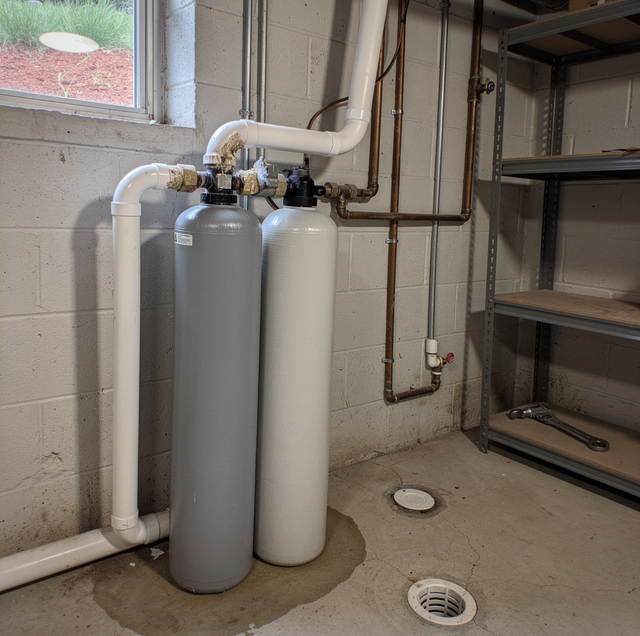
A water softener stands in your utility room with a brine tank beside it and a length of tubing running from its valve down to a drain. When the resin is spent, the valve steps the machine through a regeneration cycle, and that tubing carries the waste away. In a house with a septic system, it goes into the same tank your toilets feed into, ahead of the drain field, on a cycle the appliance chooses for itself.
That discharge gets treated as one event with one answer. The water and the salt in it behave differently once they are inside the tank, and the evidence for each is of different strength. Running them together is how both halves get answered wrong.
Where Does a Softener's Regeneration Water End Up?
Your softener's drain line has to go somewhere, and that was a plumbing choice made at installation. Tied into the building's waste piping, it delivers into the septic tank ahead of the field, at the inlet your kitchen sink uses. Run to a separate vessel, it never reaches the tank. Where that line may terminate is a question for your local health authority.
Backwash gets attached to the whole cycle. On your softener's controller, it lists the steps in a fixed order: the machine fills the brine tank, draws brine through the resin, backwashes the bed, then rinses it. The salt leaves during the brine draw and the rinsing after it, so the step that word names is not the salty one.
Whether any of it matters is a question about water, and then about salt. How much comes down that line, and how fast, is a property of the machine. What the salt does begins only once the discharge is standing in the tank.
Two Gallons a Minute for Half an Hour
The specification table in one softener's use and care guide lists that model's total water used per regeneration at its maximum salt dose as 54.7 gallons and its maximum drain flow rate as 2.0 gallons per minute. Those two figures give the event its shape: 54.7 gallons leaving at 2.0 gallons a minute takes about 27 minutes. The same table rates its service flow to your house at 8.0 gallons a minute, four times the drain rate.
So, a thousand-gallon tank takes on nearly five percent of what is standing in it, spread over close to half an hour, at a quarter of the rate that the appliance delivers to your tap. That is not the profile of a dumped load, and it sits well away from the picture the question carries. Your softener's sheet gives its two numbers, and those describe your tank.
The Waste Carries Back the Hardness It Removed
Softening is an exchange. The resin removes calcium and magnesium from your incoming water and releases an equivalent concentration of sodium in their place, and it does so until the resin is loaded and can hold no more.
Regeneration reverses it with enough sodium to break the bonds the hardness formed. So the waste going down your drain line is not brine on its own: it carries the sodium that did the stripping, as well as the calcium and magnesium that came off the resin. The proportion between them, on an equivalent basis, is the monovalent to divalent ratio.
An industry-funded laboratory study ran that ratio across columns loaded with septic tank solids. At a ratio of 11, the solids and oxygen demand leaving the column rose. At 5, that effect was greatly lessened. At 3, the effluent was better than in runs where the waste was diverted. Those points step down the ratio scale, from the most sodium-heavy waste to the least.
Scope matters as much as the finding. Those results came from columns and house tanks in New York, while tanks in North Carolina in the same study showed no clear relationship at all. Water-treatment industry guidance on brine disposal asks whoever services a softener to predict the ratio and hold it at 5 or below where the discharge goes to your tank.
Chloride Against the Bacteria, Measured in Real Tanks
A field evaluation of real septic tanks sampled 75 of them: 27 taking softener backwash and 48 not. Mean chloride in the sludge climbed from 146 to 1,515 milligrams per liter in the tanks receiving it, and mean sodium from 239 to 548. The outlet measures held. Neither carbonaceous biochemical oxygen demand, nor suspended solids, nor E. coli separated the two groups.
Sodium does slow the organisms doing anaerobic work. Reviews of anaerobic digestion put moderate inhibition at 3,500 to 5,500 milligrams a liter of sodium, a range stated for engineered digesters rather than for your buried tank. The 548 those Ontario tanks measured is roughly a sixth of the bottom of it. The chemistry holds; the concentration triggering it is not what those tanks carried.
The Salt Setting on the Machine Moves That Ratio
Which softener you own barely enters into the ratio. How much salt the controller spends each regeneration is a setting, which means you can look it up and a water treatment professional can change it without replacing anything.
Salt efficiency is the number of grains of hardness removed per pound of salt, and the guide that carries the flow figures gives the range one machine covers. That model is rated at 4,230 grains per pound at its 2.6-pound minimum dose; its largest setting buys 31,100 grains for 13.4 pounds, which works out near 2,300; and its efficiency function, switched on, holds it at 4,000 or better by regenerating more often on less salt. Those numbers are ordered by salt dose, and they put one machine at three places on the scale the column study used, with the improved case near 3,000 and the damaging case near 1,000. The guide states the softener ships with that function off.
Nothing in your house looks any different at either end of that range. The water feels soft, the salt gets topped up, and the setting behind it all goes unread for years.
Rust Lines on the Inside Face of a Concrete Tank
A pumper drawing your tank down to the floor rinses the walls, because nothing on them shows through a film of solids. After that, the pattern is all there is to go on. Staining that wanders is one thing. Staining that runs straight and parallel, in a line you can follow along the wall, is a reinforcing bar coming through its cover.
An open riser stays open only while someone is standing at it: the shaft is a fall hazard, and the gas in it can drop a person leaning over the opening, so the lid goes back on before anyone walks away.
The materials question carries a hedge. Chloride reaching embedded steel breaks down the passive film, keeping it from rusting, and the rust that forms takes up two to four times the volume of the steel, cracking the cover from inside; concrete industry guidance states that mechanism plainly. The same field evaluation, finding nothing between its two groups, closed on the one thing it could not rule out: that high chloride concentrations from softener backwash could accelerate corrosion in reinforced concrete tanks. Could play a role is the whole claim, and nobody has taken it further.
Frequently Asked Questions
Less than you would hope. Potassium carries a single charge, the same as sodium, so it sits on the monovalent side of your ratio and the arithmetic barely moves. It does change your machine's timing: the softener's guide carries a salt type setting, and selecting potassium chloride varies the cycle times because it dissolves more slowly. Set the type to match the salt you actually pour in.
Everything downstream of it. Hardness in grains per gallon fixes how many grains your resin has to hold before it is spent, so the same softener on 25-grain water regenerates about three times as often as it would on 8-grain water, and every regeneration is another discharge at your tank. The guide for that model caps maximum supply hardness at 100 grains per gallon. Your water test report gives the number to start from.
By what your pumper measures across two visits rather than one. Sludge and scum depth, taken the same way each time, gives an accumulation rate you can compare. In the tanks that field evaluation sampled, that rate came out at 117 liters per person per year, and it was no different in the tanks receiving backwash than in the ones without it, so you need a baseline. Ask for your depths in writing.
Physically, yes, and the study results are not what people expect. In that same study, tanks not receiving regeneration waste had higher values on most measures, which points to a real penalty for stripping calcium and magnesium from your water and never handing them back. A separate vessel is one more thing to maintain on your property. Whether that route is permitted where you live belongs to your local health authority.
It changes how much cover your steel still has. The concrete guidance holds that chloride needs four times as long to reach a bar sitting two inches deep as one sitting an inch deep, so cover thickness buys the delay. Your tank, if it has already lost surface material, has less of it left than the day it was set, which is worth knowing before you wave the question away.
The ones you use. Federal onsite wastewater guidance says that design flow is commonly based on the number of bedrooms in a house, assuming 150 gallons per bedroom per day, and an occupancy estimate based on the room count. A softener discharging on a trigger of its own was never among them, so its water sits outside the number your system was built against. Your local health authority holds the basis actually used.
Ask for a wall check at your next pumping — once the tank is drawn down, a technician can see what years of softener discharge have done to the walls, which stay hidden while the liquid is in the way. 3rd Generation Septic serves Lincoln, Pell City, and Talladega. Call (256) 330-6960.
