
What Is a Septic Distribution Box? The Part That Saves Your Field
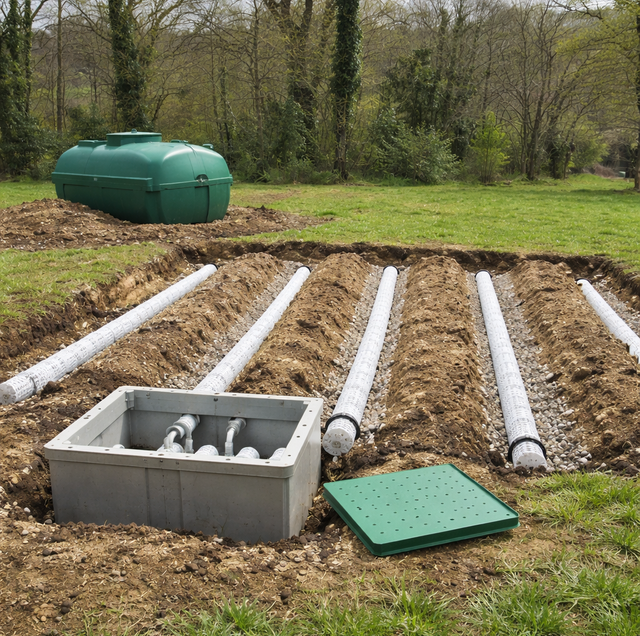
Quick Answer: A septic distribution box (D-box) is a small buried chamber between the septic tank and the drain field. Its one job is to receive settled liquid from the tank and split it evenly among the drain-field lines so no single trench takes more than its share. When the box sits level, and its outlets stay clear, the whole field ages together. When it tips, cracks, or clogs, one trench gets flooded while the rest sit dry, and the field starts failing years ahead of schedule.
What A Distribution Box Is And Where It Sits
Your septic system has three working stages: the tank, the distribution box, and the drain field. Wastewater leaves the house and enters the tank, where solids settle to the bottom as sludge and grease floats to the top as scum. The clarified liquid in the middle, called effluent, is what moves on. That liquid does not go straight into the ground. It passes through the distribution box first.
The D-box is a squat concrete or heavy-duty plastic chamber, often not much bigger than a milk crate, buried a short distance downstream of the tank. One pipe comes in from the tank. Several pipes leave it, each one feeding a separate trench, called a lateral, out in the drain field. A typical field has anywhere from three to a dozen laterals, and every one of them starts at an outlet in this box.
Because it is buried and rarely thought about, the D-box is the most overlooked part of the whole system. It has no moving parts and needs no power, yet the health of a field that costs a great deal to replace often comes down to whether this one small box is doing its quiet job.
The one job it has: The distribution box exists to divide flow evenly. Effluent enters, pools briefly, and then spills out through the several outlet pipes so each lateral in the field receives a roughly equal share. Even sharing is the entire point. A drain field is designed on the assumption that all its trenches soak up liquid at the same steady rate, spreading the load across the maximum amount of soil.
Why Even Distribution Matters So Much
A drain field is really a large filter made of gravel-lined trenches and the soil beneath them. Soil can only absorb so much liquid per day before it saturates. Spread the daily flow across every trench and the soil has time to accept the water, let bacteria treat it, and dry out between doses. Dump the same volume into one or two trenches instead, and that patch of ground never gets a chance to recover.
An unbalanced box is a slow-motion failure. Send too much to a single lateral and its soil stays waterlogged, the pores clog with a black biological mat, and that trench stops accepting liquid. The load then shifts to the next trench, which floods and fails in turn. One outlet feeding too heavily can retire a field years before its natural lifespan, while the untouched trenches on the other side sit barely used.
A drain field is like a set of drain lanes at a busy toll plaza: when every lane takes an equal stream of cars, traffic keeps moving; funnel everyone into one lane, and it jams solid while the empty lanes do nothing. The distribution box is the attendant waving cars evenly across the lanes, and a tilted or clogged box waves them all into the same one.
Why level installation is the whole ballgame: For a box to split flow evenly, its outlets must sit at the same height. Effluent finds its own level, so if the box tilts even slightly, liquid runs out the low outlets first, and the high ones may never see a drop until the flow surges. A box set truly level, on compacted and stable bedding, is what keeps every lateral in the rotation. This is why leveling is skilled work: a difference of a fraction of an inch across the outlets changes how the entire field is loaded.
Common Problems That Take A D-Box Out Of Balance
Most D-box trouble comes down to the box no longer sitting level or its outlets no longer flowing freely. A handful of causes account for nearly all of it.
It settles or tips: The ground under a buried box is not perfectly stable. Bedding soil compacts unevenly over the years, heavy equipment or vehicles pass over the area, and the repeated wet-dry cycling of the soil around it shifts its footing. Any of these can tilt the box out of level. Once it tips, the low outlets carry most of the flow, and the high ones go quiet.
Roots find their way in: A buried box surrounded by moist, nutrient-rich effluent is exactly what tree and shrub roots seek out. Fine roots work into joints, pipe seams, and any hairline crack, then thicken over time. A root mass can block an outlet entirely or lift and displace the pipe it grows around, throwing off the balance the box was set to hold.
It cracks or fills with solids: Older concrete boxes can crack from soil pressure, freeze-thaw movement, or simple age, which lets groundwater seep in and effluent seep out where it should not. A related problem is solids carryover: if the septic tank is overdue for pumping, sludge and scum escape the tank and settle in the box, where they can build up, harden, and bury the outlet openings.
Outlets clog: Even without a tank problem, an outlet can foul with biological slime, grit, or a lodged bit of debris. A partly blocked outlet quietly starves its lateral, sending that trench's share to the others, which is the same imbalance a tilt creates, just from the outlet side.
Symptoms Of A Failing Distribution Box
You will not see the box, but the field tells on it. Watch for these signs.
- One wet or spongy area over the field: A single soggy patch, greener grass in one spot, or standing liquid concentrated over part of the field points to one lateral taking far more than its share, a classic tilted-box or blocked-outlet signature.
- The rest of the field stays bone dry: The flip side of the same problem: much of the field looks untouched while one corner suffers, meaning flow is not being shared.
- Slow drains or backups indoors: When outlets are clogged, or the box has filled with solids, liquid cannot leave fast enough, and that pressure can back up toward the house through slow drains or gurgling fixtures.
- Odors or a lush stripe following one trench line: A line of unusually vigorous growth or a sewage smell tracing a single lateral marks where liquid is surfacing because that trench is overloaded.
These symptoms overlap with a full tank and other field issues, which is why the box is diagnosed by a professional rather than guessed at from the surface.
How A Professional Inspects, Levels, Or Replaces It
Never open, enter, or lean into a septic tank or a buried distribution box. Both hold hydrogen sulfide and other gases that can overwhelm a person in seconds, and no repair is worth that risk. Locating and digging near the system also calls for a utility locate first so a shovel does not strike a buried line.
A technician starts by locating the box, often working from the tank outlet or with a probe, and carefully excavating the lid. With the box open and the flow observed, several things get checked at once:
- Whether it sits level: A level laid across the outlets shows whether the box has tipped and by how much.
- Whether every outlet flows: Each outlet is cleared and checked so all laterals are back in the rotation, and roots or solids are removed.
- Whether the box is sound: Cracks, crumbling concrete, and root intrusion tell the technician whether the box can be re-leveled and reused or has to be replaced.
If the box is only out of level, the fix is to re-set it on stable, compacted bedding and confirm the outlets are even again. If it is cracked, root-bound, or solids-choked beyond cleaning, replacement with a new box, commonly a durable polymer unit, restores even flow. When the trouble traces back to solids escaping the tank, the tank gets pumped as part of the same visit so the problem does not simply return.
Where flow-leveling devices earn their place: A basic box relies entirely on staying perfectly level, which the ground fights over time. Flow-leveling devices address that weakness. Adjustable outlet fittings, sometimes called speed levelers, thread into each outlet and let a technician dial in the exact discharge height at every port, so the field can be balanced precisely and re-balanced later without re-setting the whole box. Baffles and flow-equalizing inserts calm the incoming surge and steer liquid evenly to every outlet rather than letting it favor the nearest one. On a field with unequal trench lengths or slight grade differences, these devices let a pro even out the loading in a way a plain box cannot, and they make future adjustments a quick tweak rather than a re-excavation.
Frequently Asked Questions
They solve the flow problem differently. A distribution box splits effluent among all laterals at once, so every trench works in parallel. A drop box, used mostly on sloped or terraced sites, feeds laterals in sequence: it fills the first trench to a set level, then overflows to the next box downhill, and so on. Drop-box systems tolerate uneven ground better, while D-box systems assume a flat, level field, which is one reason the D-box must sit so precisely level.
No. Systems that use a pressure-dosing pump often push effluent through a manifold that distributes flow by pipe sizing and pressure instead of a gravity box, and some single-trench or older designs have none. Gravity-fed conventional systems with multiple laterals rely on a D-box, and it is the standard splitting point on that common design.
A concrete box can last a couple of decades or more, while heavy-duty plastic and polymer boxes often outlast concrete because they do not crack from soil chemistry or freeze-thaw the same way. Lifespan depends far more on soil stability and root pressure at that spot than on age alone, which is why two boxes installed the same day can be in very different shape ten years later.
Often, yes, if it was built with access in mind. A box fitted with adjustable outlet levelers and a reachable lid can be re-balanced by exposing just the box lid, without disturbing the tank or the laterals. A plain sealed box buried deep with no riser is the harder case, which is why installing an access riser up to grade during any service makes every future check far simpler.
Indirectly, and in both directions. A saturated field after prolonged wet weather backs liquid up toward the box and can make a marginal imbalance surface as a wet spot, while a long dry stretch can shrink and shift the surrounding soil enough to nudge a box out of level. The box itself does not change with the weather; the ground around it does, which is why balance is checked on the box, not blamed on the season.
The overloaded lateral's soil clogs with a biomat and stops absorbing, then the load cascades to the next trench until the usable field shrinks toward zero. Because that biomat forms in the soil, not the box, a field pushed too far cannot always be brought back by fixing the box alone, and part or all of the drain field may need rebuilding, a far larger job than a box repair caught early.
Have a wet spot or a slow drain checked before the field pays for it — an even-flowing D-box is what makes a drain field last. 3rd Generation Septic serves Lincoln, Pell City, and Talladega. Call (256) 330-6960.
